
October 1, 2026
Overall Abundance Score: 79/100
Status: Up two points from last week's 77. One real, unconditional regulatory yes and a pile of battery records, with the usual asterisks, and a few stories that are a couple of weeks old.
Executive Summary
Here's a sentence I did not expect to type: the Nuclear Regulatory Commission finished early. On September 29 it approved a construction permit for TVA's Clinch River small modular reactor in Oak Ridge, Tennessee, the first commercial SMR in the country to get one. The review took 14 months, four months ahead of schedule. A federal agency, ahead of schedule, on nuclear power. Go check the date on your phone.
The rest of the week is mostly batteries, and mostly in people's homes. On September 9, during a California heat wave, about 140,000 home batteries discharged together for three hours and put 580 megawatts on the grid. That's more than a typical gas peaker plant, and nobody had to break ground on anything. Australia posted record rooftop solar and home battery installs. And the FDA approved a new Parkinson's drug, after approving the first treatments ever for two ultra-rare diseases earlier in September.
Now the part where I tell you what isn't solved. A construction permit is not a reactor. TVA still needs a separate operating license, and nothing has been built. The Parkinson's numbers come from the company that makes the drug. The rare-disease approvals are real firsts, but the data in the youngest patients is thin, and one of them has no public price yet. And three of this week's stories are outside our usual seven-day window. I'll flag each one as we go.
So what's the pattern? The slow parts got faster. A regulator, a drug pipeline, a pile of households with solar panels and batteries. One early permit is an anecdote. Two would be a trend, so that's the thing to watch.
Breakthrough of the Week

The NRC Approved America's First Commercial Small Reactor, Four Months Early
What happened: On September 29, the NRC announced a construction permit for a 300-megawatt GE Vernova Hitachi boiling-water reactor at TVA's Clinch River site. The formal review started in July 2025 and wrapped in 14 months. The safety evaluation was finished in June, and there was a public hearing in Oak Ridge in August. NRC Chairman Ho K. Nieh said, "Four months ahead of schedule is what the new NRC looks like."
Why it matters: The whole pitch for small modular reactors is that you stop treating every plant like a one-off cathedral and start building a repeatable design. That only works if regulators can review the design in a predictable amount of time. Fourteen months, on a first-of-its-kind reactor, is a useful proof of concept for the process, not just the machine.
What friction it removes: Uncertainty, mostly. Nobody wants to finance a project when the licensing clock might run two years or forever. A published schedule that got beaten instead of blown makes the next project easier to plan. TVA also had an early site permit for the location from 2019, so some of the groundwork was already done.
What to keep sober: Faster isn't the same as skipping steps, and the NRC did its safety evaluation and held its hearing. That's the system working. But it's still a construction permit. TVA needs a separate operating license before the reactor can run, and the NRC's release doesn't give a construction timeline or a cost. One early finish doesn't prove the next one will be early.
The abundance signal: Cheap, reliable, carbon-free power makes every other abundance story easier, from desalination to data centers to just running the air conditioner in September. Anything that shortens the gap between "we have a design" and "it's making electricity" counts. The hard part now is the building. Now build the damn thing.
Source: NRC press release, September 29, 2026
Major Developments

1. A new Parkinson's drug, once a day, aimed at a different target
On September 28, the FDA approved AbbVie's JUVMO (tavapadon) for adults with Parkinson's disease. AbbVie calls it the first and only selective D1/D5 receptor agonist for the condition, which is a fancy way of saying it targets specific dopamine receptors. It's a once-daily tablet, usable with or without levodopa. In the TEMPO-3 trial, patients gained 1.7 more hours of good "on" time without troublesome dyskinesia, compared with 0.6 hours on placebo. In a longer extension, AbbVie reports that 93% of patients didn't need a higher levodopa dose after 85 weeks, and 94% of early-stage patients never started levodopa. It's expected to reach U.S. pharmacies this month.
What to keep sober: Those numbers come from the company, not an independent review. A 1.7-hour gain against 0.6 for placebo is real, but it's an improvement, not a cure. The side effects are the usual dopamine-drug list, including hallucinations, low blood pressure, and compulsive behavior like gambling or shopping. And price and insurance coverage will decide who actually gets it.
The abundance signal: More options means more patients get a treatment that fits them instead of whatever's left. If the levodopa-delaying result holds up outside the trial, that's years of better function for people in early stages. That "if" is carrying a lot of weight.
Source: AbbVie, September 28, 2026
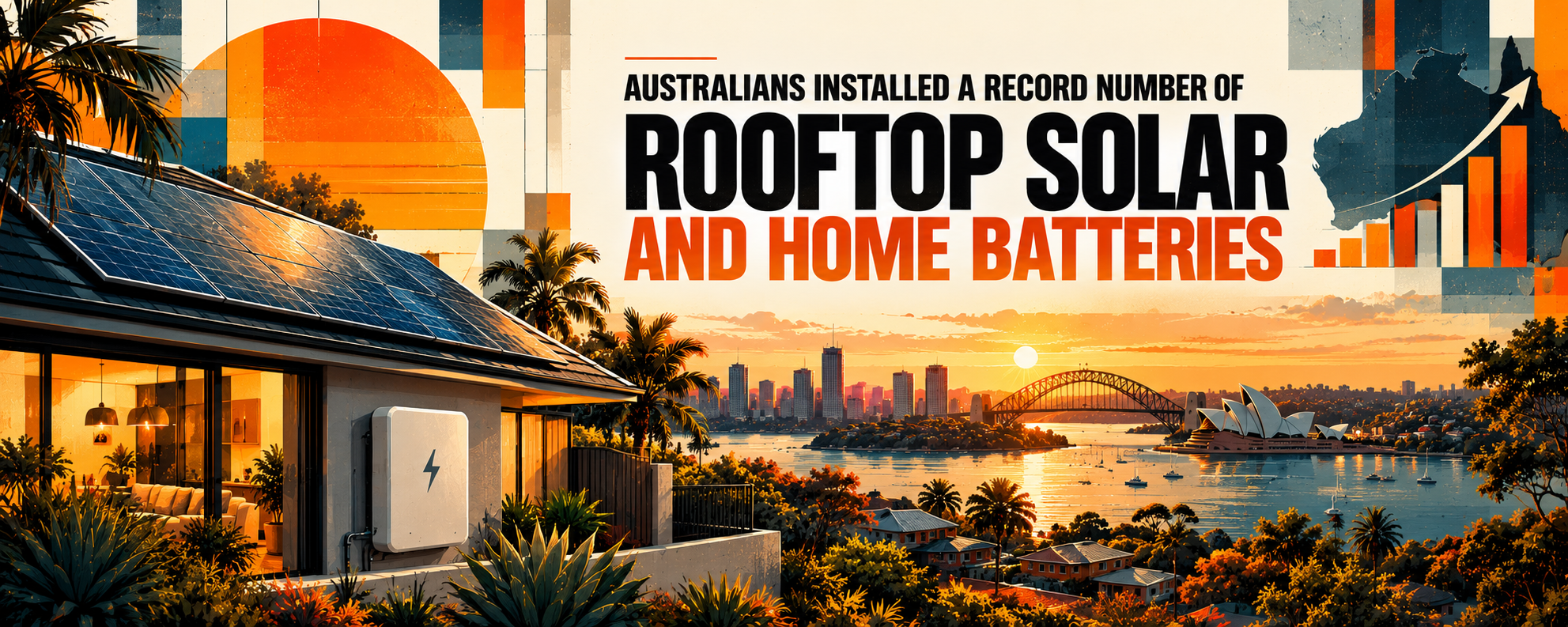
2. Australians installed a record number of rooftop solar systems and home batteries
The Clean Energy Council's first-half 2026 numbers, reported by pv magazine on September 29, are big. Australia installed 180,878 rooftop solar systems, up 35% from a year earlier, adding 1,894 megawatts. Home batteries jumped more: 276,011 installed, up 52%, adding 8,691 megawatt-hours of storage, more than double the prior period. The June quarter alone was 102,234 solar installations and 1,079 megawatts, the biggest quarter on record. A federal incentive, the Cheaper Home Batteries Program, looks like a major driver, and the report says it appears to be pulling in new solar rather than replacing it.
What to keep sober: A subsidy is doing part of the work here, and installs tend to cool off when incentives shrink. Plenty of rooftop solar is also a grid-planning problem. The report projects 40.3 gigawatts of rooftop solar in the main grid by 2029-30, about 13% above the market operator's central scenario. That's good news and a to-do list at the same time.
The abundance signal: This is the personal-agency lens in its simplest form. Households are making and storing their own power, and nobody had to approve a new power plant. They bought equipment and plugged it in.
Source: pv magazine, September 29, 2026
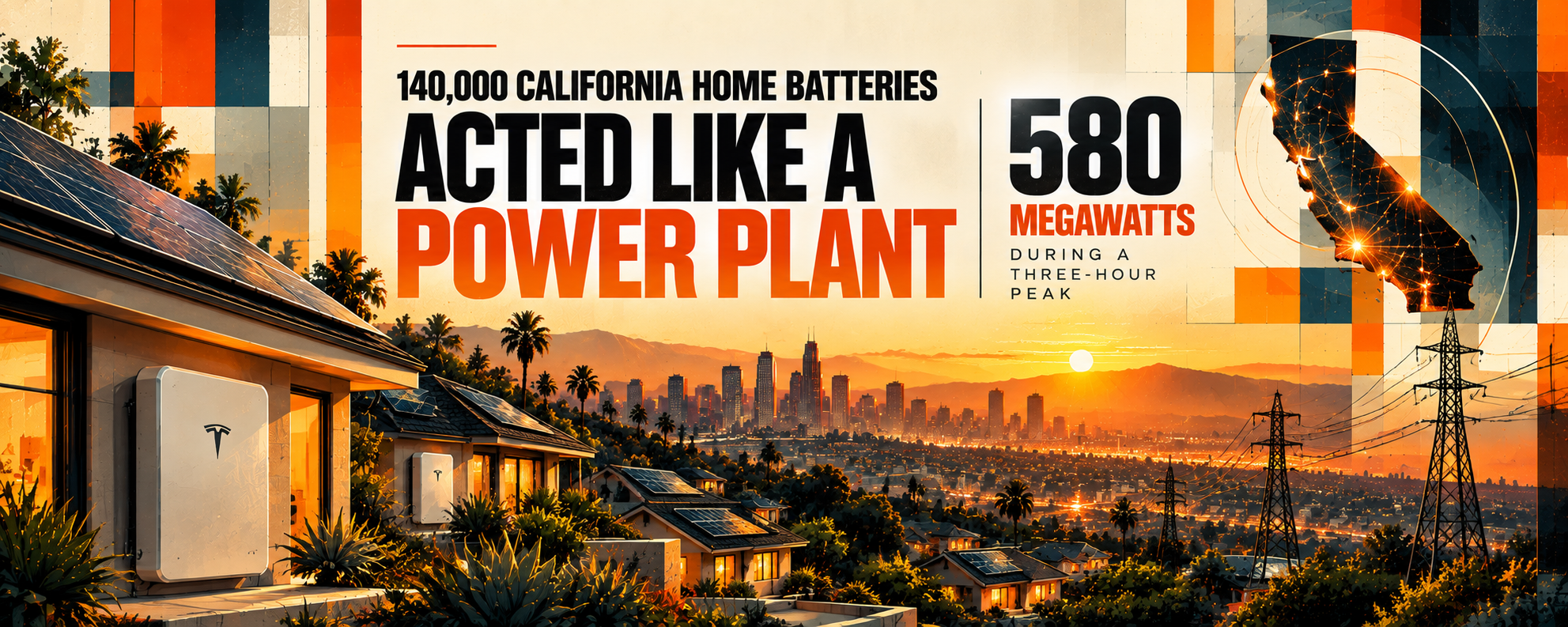
3. 140,000 California home batteries acted like a power plant, and U.S. storage set a record
During the heat wave on September 9, Sunrun and Tesla coordinated more than 140,000 home batteries to discharge during a three-hour evening peak. About 110,000 Powerwalls delivered roughly 517 megawatts, and about 30,000 batteries from other makers added 63 more, for 580 total. Electrek notes a typical gas peaker runs 50 to 250 megawatts. The dispatch ran through two California programs, the Energy Commission's Demand Side Grid Support program and the Public Utilities Commission's Emergency Load Reduction Program. Separately, the American Clean Power Association and Wood Mackenzie reported 5.4 gigawatts and 18.9 gigawatt-hours of U.S. battery storage deployed in the second quarter, a record for energy capacity, up 17% year over year. Average storage duration went from 2.8 to 3.5 hours.
What to keep sober: The California event is outside our seven-day window. It happened September 9 and Electrek wrote it up September 21. I'm including it because it's a documented record and it fits the week. The U.S. numbers have a wrinkle too: power capacity fell 7% year over year even as energy capacity rose, so the industry is building longer-lasting batteries, not necessarily more of them. And the dispatch ran through emergency programs, so how it works outside those is a fair question.
The abundance signal: A grid made of thousands of privately owned batteries is harder to switch off and doesn't need a new plant site. That's the interesting part. It's distributed, and it showed up exactly when the grid was strained. Cool. Now who owns the switch? Mostly the homeowner, plus whichever company runs the software.
Source: Electrek, September 21, 2026 and SolarQuarter, September 24, 2026

4. Two ultra-rare diseases got their first approved treatments in September
On September 3, the FDA approved Zanvastro (zilganersen), the first drug for Alexander disease, a rare progressive neurological disorder caused by mutations in the GFAP gene. It's an antisense drug injected into the spinal canal every three months. In a randomized trial of 49 patients, those 5 and older on the drug had better walking speed at 61 weeks than controls, and kids aged 2 to 4 improved on motor skills while the control group declined. On September 17, the FDA approved Ultragenyx's Fayuvi, the first gene therapy for Sanfilippo syndrome type A, an ultra-rare disease sometimes called childhood Alzheimer's.
What to keep sober: Both approvals are outside the seven-day window. I included them because they're hard regulatory firsts and I didn't find a stronger rare-disease story this week. The FDA says long-term durability for Zanvastro is unclear, and the data in children under 2 rests on four patients and modeling. For Fayuvi, STAT reported that Ultragenyx hadn't released a price, and the full article was paywalled, so I'm only stating the approval itself.
The abundance signal: A disease that hits fewer than one in a million people is exactly what the old economics ignored. A first treatment for something that had none is about as clean a win as medicine offers, even with the caveats above.
Source: FDA, September 3, 2026 and STAT, September 17, 2026
Why This Matters
The thread is speed. A regulator beat its deadline. The FDA cleared treatments for diseases that used to be written off. Households, not utilities, set battery records. Existing stuff getting through the slow parts faster.
Is that a real pattern, or am I finding one because I'm looking for it? Fair question. It would be a lot more convincing if the NRC did it twice. The caveats are specific. TVA needs an operating license and still has to build the thing. The Parkinson's drug depends on price and coverage, and the rare-disease therapies depend on manufacturing, access, and long-term follow-up. The battery stories depend on incentives sticking around and on grids that can handle all that rooftop generation. Real progress, lots of dependencies.

Abundance Index Score
This week's score: 79/100
Last week: 77/100
Change: +2
Why the score rose: Last week had no knockout. This week has one: a first-of-its-kind nuclear construction permit that came in early, for a technology that makes everything else on this list easier. Add a new Parkinson's option and genuine record numbers for home solar and storage, all checked against primary or well-sourced reporting, and it's a solid step up.
Why the score is not higher: The reactor is a permit, not electricity. The Parkinson's evidence is the manufacturer's. The rare-disease approvals are weeks old, thin in the youngest patients, and in one case unpriced. The battery records are partly subsidy-driven. And I didn't find a strong local-AI or robotics story this week, so I didn't force one.
Score interpretation: A high-70s score is a good week of verified progress with one real regulatory win and a lot of finish lines still ahead.
Looking Ahead
Does the NRC finish the next reactor review early too, or was Clinch River a one-off?
How long between TVA's construction permit and an operating license, and what will the build cost?
What will JUVMO cost, and will insurers cover it when it reaches pharmacies this month?
Does Australia's install pace hold once the home battery incentive scales back?
Can California's home-battery fleet beat 580 megawatts the next time the grid is stressed?
What will Fayuvi cost, and how many Sanfilippo patients can actually get it?
Closing Reflection
A regulator that finished early.
A reactor that still has to be built.
276,011 Australian home batteries in six months, and 140,000 in California answering the same call.
Two diseases that went from "nothing" to "something" in the same month.
Permission is still the slowest part of progress. This week it got a little faster.
Source Notes and Fact-Check
NRC construction permit for the Clinch River SMR (300-megawatt GE Vernova Hitachi reactor, TVA, 14-month review, four months early; separate operating license still required): verified as current, NRC press release, September 29, 2026.
FDA approval of AbbVie's JUVMO (tavapadon) for Parkinson's disease, with TEMPO-3 and extension figures as reported by the company: verified as current, AbbVie, September 28, 2026.
Australia's first-half 2026 rooftop solar and home battery installs per the Clean Energy Council: verified as current, pv magazine, September 29, 2026.
Sunrun and Tesla 580-megawatt California dispatch: falls outside the seven-day window (the event was September 9, the article September 21) but is included as a documented record that fits the week's storage theme; verified, Electrek, September 21, 2026.
U.S. Q2 2026 energy storage record (5.4 GW / 18.9 GWh, per ACP and Wood Mackenzie; this is secondary reporting of their monitor): verified as current, SolarQuarter, September 24, 2026.
FDA approval of Zanvastro (zilganersen) for Alexander disease: falls outside the seven-day window (28 days old) but is within 30 days and included as a regulatory first; verified, FDA, September 3, 2026.
FDA approval of Ultragenyx's Fayuvi, the first gene therapy for Sanfilippo syndrome type A: falls outside the seven-day window (14 days old) but is included for the same reason; only the approval, the company and the undisclosed price were confirmed because the full article is paywalled, STAT, September 17, 2026.