
September 24, 2026
Overall Abundance Score: 77/100
Status: Down three points from last week's 80. Last week had one unconditional yes; this week has six solid, verified stories and not one single knockout, which is its own kind of good week.
Executive Summary
Start with the phone. Every chip launch comes with a fistful of "industry-first" claims that quietly stop mattering by the time the phone actually ships. This one might earn it. Qualcomm used its Snapdragon Summit this week to announce a chip, the Snapdragon 8 Elite Extreme Gen 6, that can run a 30-billion-parameter AI model entirely on the device, no cloud connection required. Not a scaled-down model pretending to be smart. A real one, using a mixture-of-experts trick that only wakes up about 3 billion of those parameters at a time and streams the rest in from onboard storage as needed. Put the phone in airplane mode and it still answers. That's the entire pitch of "local AI when possible" compressed into a single chip announcement, and for once the marketing claim and the actual spec sheet mostly agree with each other.
Everything else this week rhymes with that one, in its own field. Commonwealth Fusion Systems got its SPARC reactor's cooling system down to 8 kelvin, colder than the surface of Pluto. One more real step toward a power source nobody has to import. IonQ showed it can correct quantum errors in real time using an ordinary CPU instead of a room full of specialized hardware. A Danish nonprofit and a construction-robotics company finished a 36-unit apartment block, printed rather than poured, by a three-person crew. And a Botswana water utility signed a ten-year contract with a private water company instead of waiting on a foreign-aid budget that keeps getting held up somewhere in legislature. Different industries, same shape: something that used to require a centralized pipe — a data center, a specialized lab, a government check — increasingly doesn't. Funny how often the missing piece turns out to be permission, not technology.
Cool. Now let's talk about what actually happens, because none of this is finished. Qualcomm's 30-billion-parameter claim comes from Qualcomm, running on phones that mostly don't ship in volume until early 2027 outside China. CFS's tokamak is still years from producing a single watt of usable power; getting the coolant cold is necessary, not sufficient. IonQ's decoder was tested on simulated benchmark circuits, not a working fault-tolerant quantum computer, because nobody has built one of those yet... anywhere. The Botswana water deal doesn't turn on a single tap until January, and this same partnership already fell apart once in Malawi over a currency problem that had nothing to do with whether the technology worked. Progress this week looks like a lot of real, verifiable steps in the right direction. It does not look like anybody crossing a finish line. Nobody's popping champagne over a signed contract.
Watch what happens when phones carrying this chip actually reach people's hands, and whether "runs offline" survives contact with a real week of real use. That's usually where claims like this either hold up or quietly get walked back.
Breakthrough of the Week

Your Phone Just Stopped Needing Permission to Think
What happened: At its Snapdragon Summit on September 22–23, Qualcomm announced two new flagship mobile chips, the Snapdragon 8 Elite Gen 6 and the Snapdragon 8 Elite Extreme Gen 6, both built on TSMC's 2-nanometer process. The company's first dual-flagship launch in nine years. The Extreme variant is the headline. Qualcomm says it's the first mobile chip that can run a 30-billion-parameter AI model fully on-device, no server round-trip required, using a mixture-of-experts architecture that activates only about 3 billion parameters per response and streams the rest in from fast onboard storage. The GPU is roughly 44% faster than last generation's, with a real bump to the neural processor as well. Xiaomi's 18 Pro and 18 Pro Max are first in line, launching in China this quarter, with Motorola, Honor, and the rest of the usual Android lineup following into early 2027.
Why it matters: Cloud AI is genuinely good at things a phone chip will never touch. Huge context windows, frontier reasoning, specialized retrieval. But a lot of what people actually want from an AI agent day to day isn't that. It's "answer this text," "summarize the document I have open," "handle this task," without shipping the contents of your phone to somebody else's server first. A chip that can run a real 30-billion-parameter model locally moves a meaningful chunk of that everyday work off the network entirely.
What friction it removes: No connectivity dependency, no per-query cost routed through a cloud provider, no round-trip latency, and (the part that matters most to me) no default requirement to hand your phone's context to a third party just to get a useful answer out of it. The AI agent that reads your calendar and drafts your reply can now plausibly live entirely on hardware you own.
What to keep sober: This is a chip announcement, not a shipped product in most people's pockets yet. A distinction the tech press loves to blur on launch day. The 30-billion-parameter claim is Qualcomm's own benchmark, not an independently verified one, and "runs offline" in a demo booth is a different claim than "runs offline well, on a phone in your pocket, at 20% battery." Most phones carrying this silicon aren't on shelves until early 2027 outside China. And hardware capable of local inference doesn't guarantee every app built for it will actually choose to use it that way instead of defaulting back to the cloud, since cloud inference is still how most companies monetize and control these agents. Ownership is mostly theoretical until the hardware's actually in your hand.
The abundance signal: This is the local-AI lens made literal. Not local instead of cloud, but local finally becoming a real option at the flagship-hardware level instead of a compromise reserved for hobbyists running quantized models on a spare GPU. When the default hardware can do it, "local when you can" stops being a niche stance and starts being a real choice on the table for the billions of people who'll never run a home server.
Source: Qualcomm, September 23, 2026
Major Developments

1. A fusion reactor's cooling system just hit -265°C, right on target
Commonwealth Fusion Systems announced this week that SPARC's full cryogenic system reached its operating temperature of 8 kelvin, about -445°F. Colder, the company notes, than the surface of Pluto. Adam Weiner, CFS's director of cryogenics, said the team has now "demonstrated an ability to cool down the system in a controlled way," which sounds modest until you remember that keeping enormous superconducting magnets at that temperature, reliably, is one of the harder engineering problems standing between "fusion works in a lab" and "fusion reactor sends power to a grid." Next up is what CFS calls a dry dress rehearsal, linking the cryogenics to the power supply and plasma-heating systems before SPARC attempts actual fusion.
What to keep sober: Fusion has been "twenty years away" for roughly sixty years, so a little institutional suspicion here is earned, not cynical. But getting cold enough is necessary. It is not sufficient. SPARC hasn't produced a watt of fusion power yet, and won't for at least another year or two on an optimistic schedule; this is one system, among several, clearing its own checkpoint. Commercial fusion has been "close" for decades, and skepticism about specific timelines remains earned even as the individual engineering milestones keep landing on schedule.
The abundance signal: Fusion, if it works at commercial scale, is about as close as energy gets to the actual definition of abundance: enormous output, minimal fuel input, no meltdown risk, no carbon. Every real engineering milestone that lands on schedule instead of slipping is a small update in favor of that bet paying off this decade rather than the next one.
Source: Commonwealth Fusion Systems, September 16, 2026

2. The world got a little less poor, mostly because we finally counted it right
The World Bank's September 2026 global poverty update puts the number of people living in extreme poverty (on less than $3 a day in 2021 dollars) at about 824 million in 2024, roughly one in ten people on Earth. That rate is projected to keep declining, from 10.1% in 2024 to 9.8% by the end of this year. Here's the part that actually made this update newsworthy instead of routine: the new estimate is 0.3 percentage points lower than the Bank's own March 2026 number, about 22.5 million fewer people in extreme poverty than previously thought, and almost all of that revision comes from better survey data out of South Asia, especially India. Nobody got richer between March and September. The Bank just finally had good enough numbers to see how much better things already were.
What to keep sober: "The number went down because we counted better" is not the sentence a press release wants to lead with, but it's the honest one. A measurement getting more accurate is not the same story as poverty actually falling faster than expected, and it's worth being honest about which one this is. The regional picture is also uneven: most of the world now sits under 5% extreme poverty, but Sub-Saharan Africa remains stubbornly high, and poverty is actually rising across the Middle East, North Africa, Afghanistan, and Pakistan corridor. Global averages can hide a lot.
The abundance signal: Still, a downward revision driven by better data is a genuinely good kind of good news, because it means the tools for measuring poverty are getting sharper at the exact moment more of the world is generating the survey data needed to use them. You can't manage what you can't measure, and for a big chunk of South Asia, the measuring just got a lot more honest.
Source: World Bank, September 22, 2026
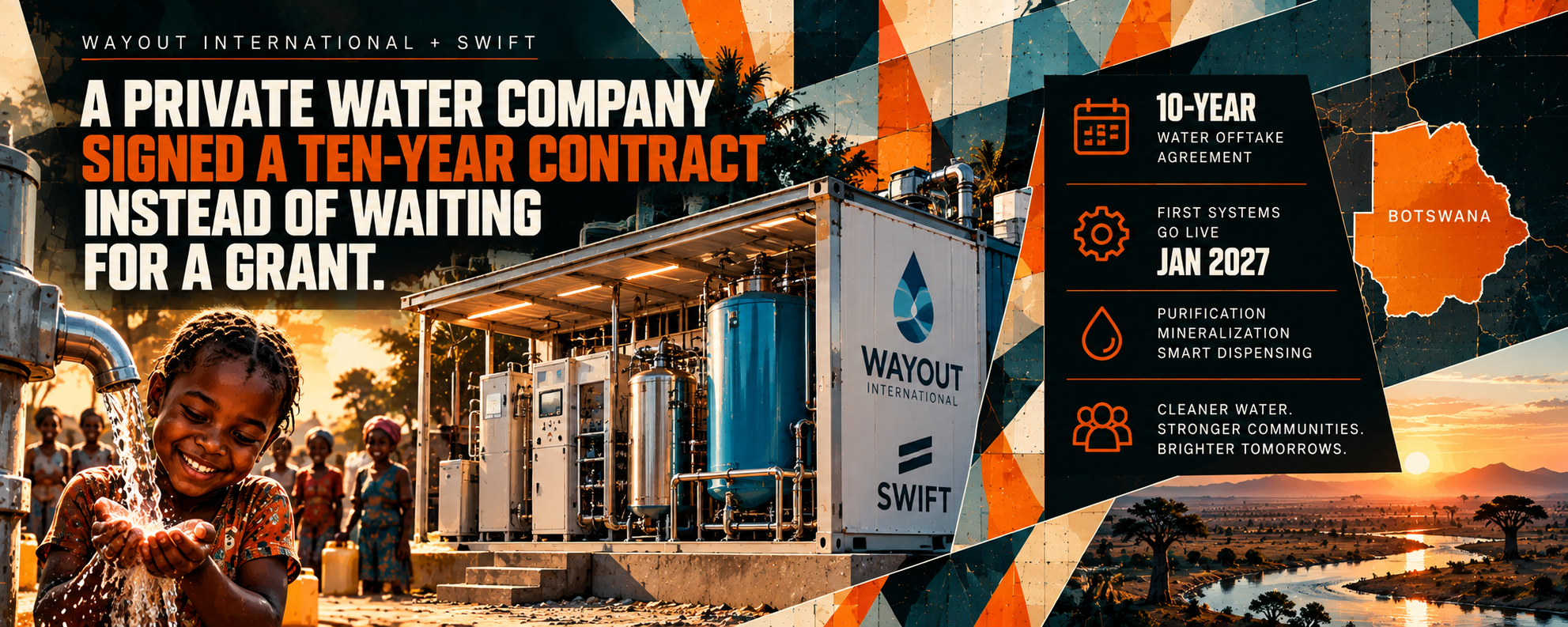
3. A private water company signed a ten-year contract instead of waiting for a grant
Wayout International, which builds distributed drinking-water systems combining purification, mineralization, and smart dispensing, signed its first Botswana infrastructure contract this week alongside Swift, a Southern African water-infrastructure company that started out in Malawi. The deal is backed by a ten-year water offtake agreement. Meaning someone in Botswana has committed, in writing, to buy the water for a decade, which is the kind of financial structure that lets a company actually build something instead of waiting on the next aid disbursement cycle. First systems go live in January 2027. Worth noting: this same partnership originally tried to launch in Malawi and got stuck there on foreign-exchange constraints that had nothing to do with whether the technology worked.
What to keep sober: Nothing has been installed yet. This is a signed contract with a few months of runway before the first system turns on, and the Malawi stall is a real reminder that financing structures can still fail for reasons that have nothing to do with engineering. A ten-year offtake agreement is a strong signal of seriousness. It is not water in anyone's cup yet.
The abundance signal: This is the personal-liberty lens showing up in infrastructure form: a commercially financed water contract, standing on its own economics, is more durable than a donation that depends on some other country's budget cycle surviving contact with politics. When the deal makes money for everyone involved, it doesn't need to be re-approved every fiscal year.
Source: Engineering News, September 23, 2026

4. A quantum computer corrected its own errors using a chip you could buy off a shelf
IonQ says it has demonstrated the industry's first real-time, end-to-end quantum error decoder that runs on a single standard CPU. No specialized supercomputer required. In testing across benchmark circuits simulating 408 logical qubits and more than 31.5 million quantum operations, the decoder kept up with the error-correction workload continuously, adding as little as 0.02% processing overhead. That matters because quantum error correction has historically been one of the ugly bottlenecks standing between "quantum computer that works in short bursts" and "quantum computer that stays useful long enough to do something," and the assumption has generally been that decoding those errors in real time would require exotic, purpose-built classical hardware bolted onto the machine.
What to keep sober: Quantum computing has been "five years from mattering" for most of the last fifteen. This was tested on simulated benchmark circuits, not on a live, fully fault-tolerant quantum computer running real workloads, because that machine doesn't exist yet anywhere. It's IonQ's own result, not an independently replicated one, and validating a decoder against a benchmark is a different claim than validating it against the messier noise of an actual production system at scale.
The abundance signal: Cheap, off-the-shelf classical hardware doing a job that was assumed to need something exotic and expensive is exactly the kind of unglamorous cost collapse that tends to matter more than it sounds like it should. If it holds up, it's one less reason a fault-tolerant quantum computer needs to be a billion-dollar facility instead of something closer to a large server rack.
Source: IonQ, September 22, 2026

5. Thirty-six apartments, printed by the same three people, over and over
A Danish nonprofit housing developer, NordVestBO, working with construction-robotics firm 3DCP Group and architects SAGA Space Architects and MS+, finished Skovsporet, a 36-unit student apartment complex in Holstebro, Denmark, printed on-site with a COBOD BOD3 robotic printer run by a three-person crew, now being called Europe's largest 3D-printed housing project. The buildings went up over about 12 months, using a lower-carbon concrete mix, with a bike shed that used zero cement and cut emissions by 84% compared to a conventional build. Architect Sebastian Aristotelis put the real achievement plainly: the hard part was never printing one unit successfully. It was doing it 36 times in a row without the process falling apart.
What to keep sober: This story is a couple of weeks old as of this issue, a bit outside our usual seven-day window, but it's a completed project, not a pitch deck, and that's rare enough in construction-tech coverage to be worth the exception. Thirty-six student apartments for a nonprofit housing authority is also a specific, subsidized use case. Not yet proof a for-profit developer gets the same economics building market-rate housing without that institutional backing.
The abundance signal: The interesting number here isn't square footage, it's repeatability. A construction technology that works once is a demo. One that works 36 times in a row, with the same small crew, at declining marginal effort, is the beginning of an actual dent in the labor bottleneck that makes housing expensive almost everywhere.
Source: Yanko Design, September 4, 2026
Why This Matters
Six stories, six industries, and if you squint it looks like a coincidence. It isn't. Look at what's actually common across them: a phone chip, a fusion reactor's coolant, a poverty statistic, a water contract, a quantum decoder, and an apartment building. None of them are about a new idea nobody had before. They're about something that used to require a centralized, gatekept piece of infrastructure learning to do without it. The AI model doesn't need the data center. The quantum decoder doesn't need the specialized supercomputer. The water utility doesn't need the foreign-aid budget. The apartment building doesn't need a small army of skilled tradespeople repeating the same task by hand. Even the poverty number is a story about better local data collection outperforming a distant estimate.
Is that a real pattern, or is this newsletter just good at finding a thread in whatever landed in the inbox this week? Fair question. Fusion power is still gated behind an actual reactor that hasn't run yet, water access in Botswana is still gated behind a contract that hasn't delivered a drop, and the housing win is still gated behind whether it works without a nonprofit client absorbing the risk. Nothing here has fully escaped its gatekeeper. What's changed is which gatekeeper, and how many steps stand between here and the exit.
Abundance Index Score
This week's score: 77/100
Last week: 80/100
Change: -3
Why the score fell: Last week had one complete, unconditional win: a first-ever approved treatment for a disease that had none. This week has no equivalent single knockout. What it has instead is unusually good breadth: six verified stories, spanning AI hardware, energy, quantum computing, water, housing, and global poverty data, several of which (the chip, the poverty numbers, the finished apartments) are already real and shipped rather than still pending. Breadth without a knockout still counts as real progress. It just doesn't score quite as high as a single dramatic yes.
Why the score is not higher: Every story this week has a real asterisk attached. The chip's headline claim is unverified outside Qualcomm's own numbers and won't reach most phones until 2027. The fusion milestone is a checkpoint on a multi-year path, not power on a grid. The water contract hasn't delivered water. The quantum decoder was tested on simulations. The housing project is subsidized student housing, not proof the model works at market rates. Real movement, on a lot of fronts, none of it finished.
Score interpretation: A high-70s score means a genuinely good, broad week of verified progress with no single dramatic finish line crossed.
Looking Ahead
Does the Extreme Gen 6's 30-billion-parameter on-device claim hold up in daily use once phones like the Xiaomi 18 Pro Max are in real hands, not just Qualcomm's demo booth?
Does CFS's cryogenic system survive the coming "dry dress rehearsal" that links it to the power supply and plasma-heating systems?
Does the World Bank's downward poverty revision hold, or does it get partly walked back the way these estimates sometimes are?
Do Wayout and Swift's Botswana systems actually go live in January 2027 on schedule, given that this same partnership already stalled once in Malawi?
Does IonQ's real-time decoder keep its 0.02% overhead once it's tested against real hardware noise instead of simulated benchmark circuits?
Does Skovsporet's construction-cost story hold up once a for-profit developer tries the same approach without a housing nonprofit absorbing the risk?

Closing Reflection
A phone that doesn't need the cloud to think.
A tokamak two degrees off absolute zero, and still climbing.
A poverty number that fell because the measuring got better, not because the world got kinder.
A water contract nobody had to donate.
A quantum computer correcting itself on a chip you could buy off a shelf.
Thirty-six apartments, printed by the same three people, until "again" stopped being a miracle.
Abundance doesn't usually announce itself. It just quietly stops asking permission.
Source Notes and Fact-Check
Qualcomm announcing the Snapdragon 8 Elite Extreme Gen 6 as the first mobile chip able to run a 30-billion-parameter AI model fully on-device: verified current, Qualcomm, September 23, 2026.
Commonwealth Fusion Systems reaching the 8 kelvin operating temperature for SPARC's full cryogenic system: verified current, Commonwealth Fusion Systems, September 16, 2026.
World Bank's September 2026 global poverty update revising extreme poverty down to roughly 824 million people (about 10.1% in 2024, projected 9.8% by 2026), a 0.3-point downward revision from March 2026 driven mainly by updated South Asian survey data: verified current, World Bank, September 22, 2026.
Wayout International and Swift signing a ten-year water offtake agreement to deploy distributed drinking-water infrastructure in Botswana, first systems live January 2027: verified current, Engineering News, September 23, 2026.
IonQ demonstrating a real-time, end-to-end quantum error decoder running on a single standard CPU across simulated benchmark circuits of 408 logical qubits: verified current, IonQ, September 22, 2026.
NordVestBO, 3DCP Group, and architects SAGA Space Architects and MS+ completing Skovsporet, a 36-unit 3D-printed student housing project in Holstebro, Denmark, described as Europe's largest 3D-printed housing project to date: falls slightly outside this issue's seven-day window (published September 4) but included because it's a completed project rather than a pitch, and directly relevant to housing-construction abundance; verified current, Yanko Design, September 4, 2026.